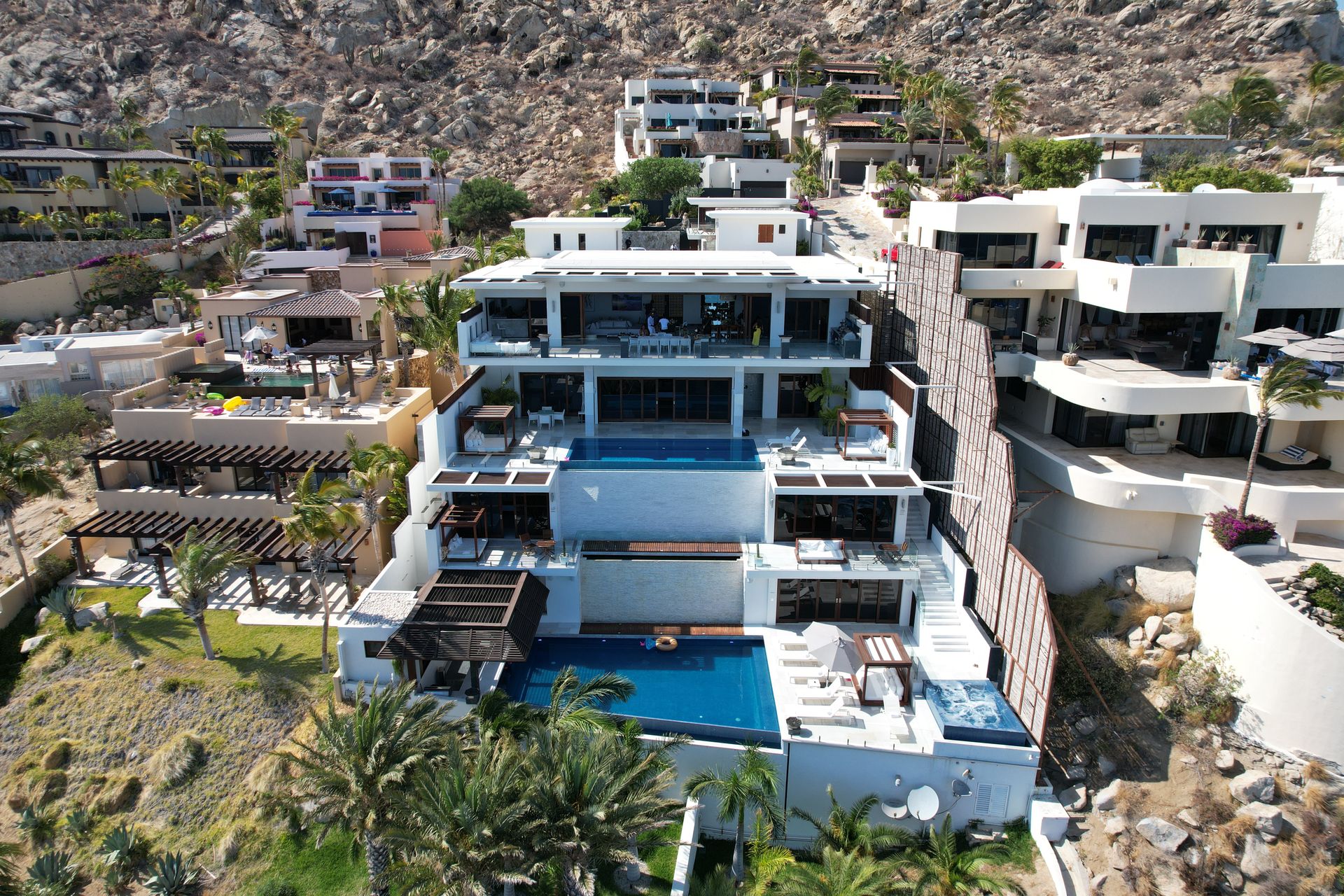
Ask three Los Cabos managers what they do and you will hear the same sentence three times. Listings, guests, housekeeping, maintenance.
It is accurate, and it leaves out the two things that decide how a Cabo villa actually performs. Most high-value villas here sit inside gated communities with their own rules, gates and desks, and a large share of the job happens there before a guest ever sees the house. The house itself sits in a desert on the Pacific, which wears on it in a way a tropical jungle does not, and through a hurricane season that runs from mid-May to the end of November.
Managing a Cabo villa is managing both of those. The listing sits on top.
Two kinds of Cabo villa
The first question is where the villa sits, because it changes the job more than the bedroom count does.
Inside a gated community, the owner shares some of the load. Security is staffed. Roads and common areas are maintained. In some communities the HOA runs services that a standalone house would have to arrange alone. In exchange, the villa answers to a rulebook: rental registration, guest documentation, vendor access windows, vehicle credentials, noise and occupancy rules, and in some cases a sub-HOA inside the main one with rules of its own.
A standalone villa outside a gated community has none of that structure and none of that help. Every system on the lot is the owner’s, security is the owner’s problem, and nobody else is watching the street. The rulebook is shorter. The maintenance list is longer.
Neither is better. They are different jobs, and a manager who describes them the same way is describing neither.
Half the job happens at the gate
In Pedregal, Palmilla and Querencia, a surprising amount of villa management is administrative, and almost none of it can be done from abroad.
Each stay has to be registered and documented before arrival. Housekeepers, pool technicians, chefs and grocery deliveries need standing credentials or a pre-arranged access window. Guest vehicles get logged. HOA notices arrive in Spanish and need answering. Dues have to be current, because a lapsed account can block a guest at the gate. In Palmilla, the sub-HOAs, not the main HOA, are where the rental rules actually live. In Querencia, guest access to the golf course and the beach club depends on arrangements the owner holds as a member.
When any of these lines breaks, the guest finds out first. A late-night arrival with no name on the list, a chef turned away at the gate, a guest expecting club access that was never arranged. These are where Cabo villas lose the first star of a review before anyone unpacks.
Our own approach to this layer is set out community by community on the Pedregal, Palmilla and Querencia pages.
Water and power in a desert
Los Cabos is a desert. The region depends heavily on desalinated water alongside its aquifers, and municipal supply to individual homes is not always continuous, so many villas store water in a cistern and pump it to the house. Pedregal goes a step further, with a community desalination plant that predates the municipal one. Either way, someone has to watch storage levels, service the pumps and pressure system, and know who to call when supply drops in the middle of a full house.
Power is the line owners misbudget most. Air conditioning runs hard for much of the year, and once a villa’s twelve-month consumption average crosses the CFE high-consumption threshold, the whole account moves onto the DAC tariff and stays there until the average comes back down. The mechanics are covered in what electricity actually costs a Los Cabos villa. The management implication is simple. Thermostat discipline between guests, AC servicing, and watching the bill month by month are part of the job, not an afterthought.
Sun, salt, wind and the Pacific season
Cabo’s wear curve is different from the Caribbean’s. The damage comes from UV, salt and wind rather than humidity. Exterior finishes fade, metal corrodes, outdoor fabrics break down, glass and railings carry a salt film within days. Good maintenance here runs on a calendar: regular exterior washing through the dry months, a full pre-season audit in May, staged storm protocols through the season, and a recovery sweep before high season opens.
The hurricane season runs from May 15 to November 30, with peak risk from August through October. Preparation means securing outdoor furniture and shading, checking drains and roofs, testing water and backup systems, communicating with any guests in the house, and documenting the villa’s condition before and after a storm. An owner abroad should never have to ask what the villa looked like the morning after.
Two seasons, two kinds of management
Cabo is a two-calendar market. Peak runs roughly October through May, with long bookings, high nightly rates, tournament weeks and full concierge calendars. Shoulder runs June through September, when demand thins, pricing softens and the hurricane season overlaps the slowest weeks.
Peak is largely won by the house itself. Shoulder is won by operations: pricing that holds without giving the villa away, minimum stays that bend at the right time, maintenance work scheduled into empty weeks instead of booked ones. The full argument is in why June to September determines the annual return.
Guests change with the season too. Peak brings families, golf groups and celebrations, along with requests for private chefs, transfers, tee times, boat days and beach club access. Arranging these is part of the product in Cabo, not a courtesy.
How villa management is usually priced
Most full-service villa management in Los Cabos is priced as a percentage of rental revenue. That number gets the attention. What sits around it matters more.
The first question is what the percentage includes. In some arrangements it covers guest communication and pricing, and the HOA administration, staff supervision, maintenance coordination and reporting are billed separately. In others it covers the whole operation. Two quotes with the same percentage can describe very different jobs.
The second question is what stays with the owner. HOA dues, utilities, club memberships, pool service, gardening and supplies are usually owner costs. Guest cleaning is usually charged to guests. Repairs are where structures differ most: billed at cost, billed with a coordination charge, or built into a margin. Each can be fair. The owner should know which applies before the first invoice.
The third question is how the arrangement sits next to the community. Some HOAs run their own rental program alongside independent management, and a resort or condo-hotel program works on different economics from an independently managed villa. The differences are laid out in condo-hotel versus standalone villa in Cabo. Know which model you are in before comparing quotes.
Whatever the structure, it belongs in writing before anything is signed.
What reporting should show
An owner in Dallas, Toronto or Zürich sees the villa through reporting. For a Cabo villa, that should mean bookings and revenue by channel, every expense with its receipt, the HOA correspondence for the month, the staff and service log, and dated photographs of the rooms, pool, systems and exterior. Anything that needs a decision should arrive with a recommendation and a cost.
The foreign-ownership layer sits alongside this. Fideicomiso administration, lodging-tax registration and the tax filings that go with rental income in Mexico involve the owner’s bank and accountant as well as the manager, and the reporting should make that coordination easy rather than leave the owner to assemble it. The broader picture is in Los Cabos rental management for foreign owners.
What to ask before signing
A handful of questions sort the conversation quickly. Which communities do you already operate in, and do your vendors hold standing credentials there? Who handles HOA registration and guest documentation for each stay? What does the percentage include, and what stays with me? How are repairs billed? What is your hurricane protocol, and what will I receive after a storm? What will my monthly report look like, and can I see a real one?
The answers show whether the arrangement covers the listing or the whole villa.
Our own approach to Los Cabos property management is built around the gate, the house and the season, in that order. For villas still being finished or refreshed, Los Cabos interior design covers the furnishing side.